
As part of the European Tools4NDDs project, the Rudolf Berlin Center (RBC) is currently hosting international guest researcher Aino Sorsa. Aino is a PhD Researcher at the Centre of Excellence in Learning Dynamics and Intervention Research (InterLearn) at the University of Jyväskylä in Finland, where she studies learning and developmental difficulties in children and adults.
During her eight-week stay, she is collaborating with researchers at the RBC and further exploring the transdiagnostic approach that lies at the heart of the Tools4NDDs project.
We spoke with Aino about her research, her experience at the RBC, and the value of international collaboration.
Can you tell us a little about yourself and your research?
“I have always been interested in how we learn, and why learning is easier for some people than for others. I have also been curious about differences between children and adults in learning, for example when acquiring a new language.
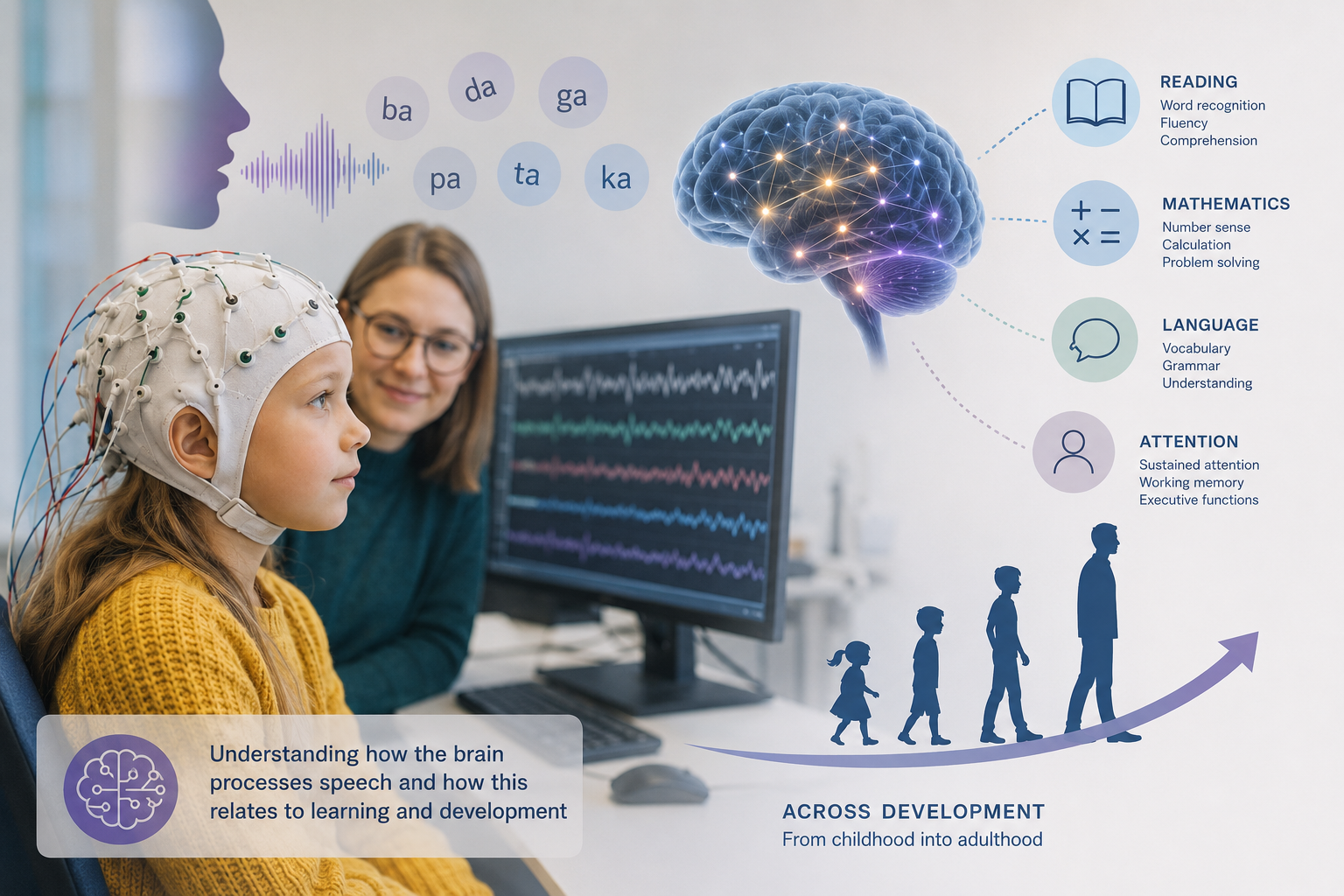
In my PhD research, I have the opportunity to study speech perception and processing in both children and adults, using two longitudinal datasets: the adult data from the Jyväskylä Longitudinal Study of Dyslexia (JLD) and child data collected within InterLearn (InterLearn). My work focuses in particular on individuals with varying reading abilities, and on how neural level speech processing relates to reading and also to broader cognitive and academic skills.”
How do you study these processes across development?
“In my first study (Sorsa et al., 2026), we examined how brain responses to speech sounds develop from childhood into adulthood within the JLD dataset. Specifically, we wanted to see whether neural responses to speech sounds still differed in adulthood between individuals with dyslexia, typical readers, and those with familial risk but typical reading skills, and whether these responses remained linked to reading skills, as they were in childhood.
In my current work, focusing on first-grade children, we investigate the relationship between brain responses to speech and reading skills, while also taking into account broader cognitive and academic skills that often co-occur with reading difficulties, as well as differences between processing speech in native and non-native languages. As this is the first time point of a longitudinal design, comparisons across development are not yet possible. However, in addition to the child data, our separately collected adult dataset enables cross-sectional comparisons of speech processing across age groups.”
This broader perspective aligns closely with the transdiagnostic approach promoted by Tools4NDDs. Rather than focusing solely on diagnostic labels, the approach aims to understand each child’s unique profile of strengths and challenges.
Why were you interested in joining this exchange?
Aino’s visit to the RBC is made possible through the Tools4NDDs project, which brings together researchers from different countries and disciplines.
“When I first heard about this opportunity, I was immediately curious. The topics explored within Tools4NDDs are very closely related to my own research interests.”
Beyond the scientific content, she also values the opportunity to collaborate with researchers from different backgrounds.
“It is a great opportunity to strengthen my knowledge, develop new skills, and expand my professional network. During my stay, I am involved in different activities, which allows me to learn from new perspectives.”
What does a typical day as a researcher look like for you?
According to Aino, research involves much more than data analysis alone.
“My days are very varied. Of course, I spend time working on my PhD, but I am also involved in many practical aspects of our research project. This can include planning measurements, coordinating studies, communicating with participants and their families, and helping to organise project activities.”
She particularly enjoys the diversity of these responsibilities.
“You are not only focused on what needs to happen today; you are also constantly thinking ahead and preparing future stages of a project.”
What is your PhD about?
Aino’s PhD research is part of a larger longitudinal project that follows children’s development over time.
“The broader study will continue until 2029, although I’ll complete my PhD before then. My doctoral work focuses on one part of this larger project.”
The study includes measures of reading, mathematics, language skills, and attention-related characteristics, allowing researchers to investigate how different developmental domains interact with one another.
“I am particularly interested in reading development and dyslexia, but I also want to understand how reading difficulties relate to other cognitive and learning profiles.”
What has stood out to you during your time at the RBC?
Although Aino has only been at the RBC for a short time, she has already noticed strong similarities between researchers in Finland and the Netherlands.
“What always surprises me, even though I expect it, is how similar researchers are. You may be working in different countries or institutions, but in the end, you are often driven by the same questions and the same curiosity.”
For her, the most striking similarity lies not only in the research topics but also in researchers’ shared mindset.
“There is a common curiosity. We are all trying to better understand learning and development. That makes collaboration feel very natural.”
What motivates you as a researcher?
Aino speaks enthusiastically about academic life and the opportunities it provides.
“I have always enjoyed doing research and being part of academia. Of course, every job comes with challenges, but the possibility of developing new ideas and gaining a deeper understanding of how the brain works when we e.g. learn something new continues to motivate me.”
Working together to improve support for children
Aino’s visit reflects the core ambition of Tools4NDDs: bringing together researchers from different countries and disciplines to share knowledge and develop innovative approaches to supporting children with neurodevelopmental difficulties.
By moving beyond traditional diagnostic labels and focusing on each child’s individual profile, the project aims to contribute to earlier, more personalized, and more effective support. International exchanges such as this one play an important role in strengthening collaboration between researchers and accelerating the translation of scientific knowledge into practice.
The RBC is delighted to welcome Aino during her stay and looks forward to continuing the collaboration in the future.
Meer weten?
- Website InterLearn: https://www.interlearn.fi/eng
- Download het eerste artikel van Aino:

